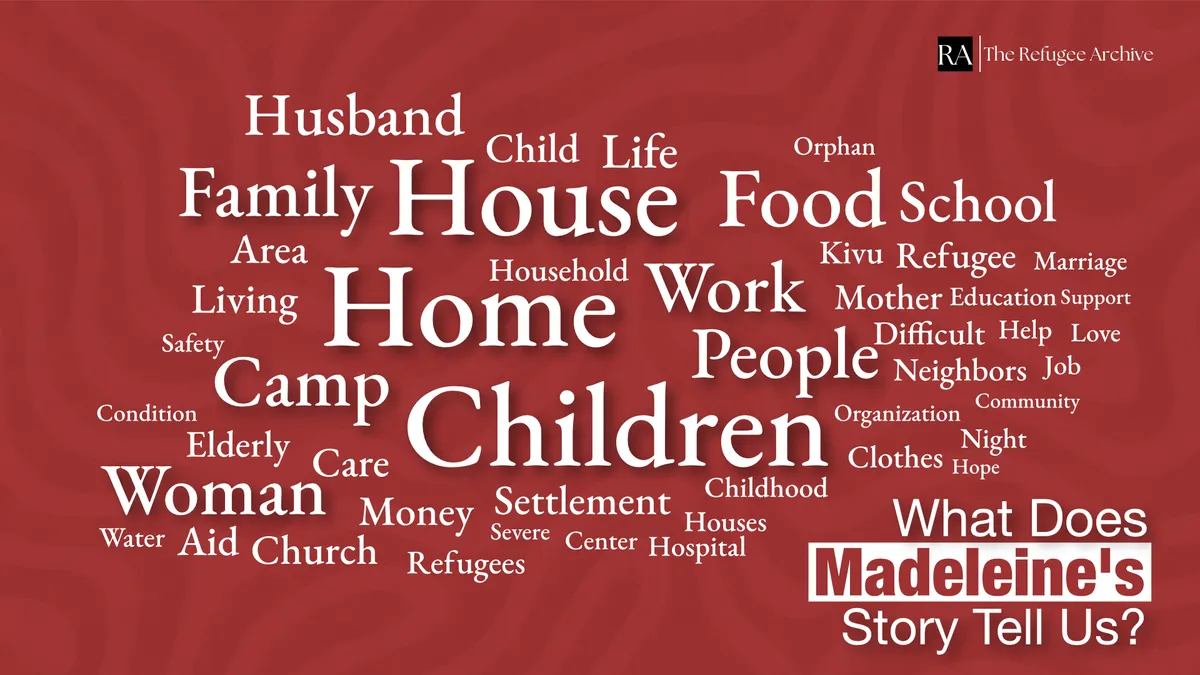
From Oral History to Evidence: What Madeleine’s Story Can Teach Us About Humanitarian Research
What happens after an oral history is recorded?
For an archive, preservation is part of the answer. For humanitarian researchers, governments, international organizations, and donors, there is another possibility: a collection of long-form testimony can also become a rich body of qualitative evidence.
At The Refugee Archive, we are exploring that intersection through the oral histories we collect with displaced single mothers and women heading households. Madeleine’s story offers a useful example.
Born in South Kivu in the Democratic Republic of the Congo, Madeleine describes childhood as an orphan, domestic work beginning at a young age, marriage, motherhood, armed violence, flight from Congo, and the realities of raising children as a single mother in Uganda’s Nakivale Refugee Settlement. Her testimony moves across family, work, education, health, humanitarian assistance, protection, displacement, and hope for her children.
Her oral history is currently available in three parts:
Part 1: Madeleine’s Story – Uganda: Life Saving Marriage
Part 2: Madeleine’s Story – Uganda: We Walked to Uganda
Part 3: Madeleine’s Story – Uganda: When I Had to Leave
Listening to those episodes tells us something a spreadsheet cannot. But that does not mean the testimony has to remain outside the evidence systems used in international development.
Moving from testimony to a qualitative corpus
International development organizations already use several approaches for analyzing large bodies of qualitative and unstructured text.
UNHCR guidance describes content and grounded analysis as common approaches in policy-oriented qualitative research. It distinguishes between deductive analysis, where researchers begin with an existing framework of issues or questions, and inductive analysis, where categories emerge from the interviews themselves. UNHCR also emphasizes that qualitative data help explain behavior, perceptions, priorities, and the context behind quantitative findings.
That distinction matters for oral history.
Imagine analyzing Madeleine’s transcript using a deductive framework based on questions already important to humanitarian actors:
Food security.
Education.
Health.
Employment.
Protection.
Housing.
Documentation.
Humanitarian assistance.
Safety.
Resettlement.
Researchers could code each relevant passage according to those categories.
But that should only be the first layer.
An inductive coding process asks what Madeleine herself repeatedly brings into the story that we may not have anticipated. Perhaps institutional distrust emerges repeatedly. Perhaps the relationship between employment and leaving children unattended becomes important. Perhaps the experience of single motherhood cuts across almost every other category.
This is where long-form testimony becomes especially valuable. Participants are not restricted to the categories researchers thought to include in a survey.
UNICEF evaluations have used this combination of approaches as well. One evaluation describes using VADER sentiment analysis alongside a bottom-up process of inductive reasoning to identify emerging patterns, narratives, and themes. Another UNICEF evaluation used both deductive themes established in advance and inductive themes that appeared during analysis.
Sentiment analysis can go further than “positive” and “negative.”
Long-form interviews should not simply be assigned one positive, negative, or neutral score.
Madeleine’s story alone demonstrates why.
The same interview contains love, grief, fear, hope, anger, gratitude, anxiety, belonging, distrust, loss, and determination. Reducing several hours of testimony to “negative sentiment” would erase most of what makes the account useful.
Instead, researchers can analyze sentiment at the segment or thematic level.
We can also use aspect-based sentiment analysis, which asks not only what emotion or opinion is being expressed? but also what is it being expressed about?
For humanitarian research, the “aspects” might be:
SCHOOLING
HEALTHCARE
FOOD ASSISTANCE
EMPLOYMENT
POLICE
CAMP ADMINISTRATION
HOUSING
DOCUMENTATION
COMMUNITY SUPPORT
RESETTLEMENT
Across dozens or hundreds of interviews, researchers could then examine whether particular systems are repeatedly associated with trust, frustration, fear, satisfaction, or hope.
That is much more useful to policymakers than saying an interview was “mostly negative.”
Here is how that works on a single moment. Imagine a passage in which a mother describes leaving her children at home so she can go to work. A deductive pass would code it Employment. An inductive pass might add a theme the framework did not include, such as childcare with no safe option. Aspect based analysis would tag the passage with the aspect employment and the sentiment anxiety. Across many interviews, the same tag would show whether work and worry travel together.
Even simple frequency analysis begins to reveal patterns.
Our initial analysis of Madeleine’s transcript offers a basic illustration.
We counted word frequency across her full transcript and left out headings and common filler words such as "the," "and," and "of." Her most frequently occurring meaningful terms include home, children, house, work, family, people, woman, camp, food, husband, school, life, money, and settlement. “Home” appears 49 times, “children” 48, “house” 42, “work” 35, and “family” 34.
Frequency alone does not tell us what those words mean.
But it tells the researcher where to look.
Why does “home” recur so frequently? Is home associated with safety, loss, belonging, housing, Congo, Uganda, or all of these at different points?
Why does “work” appear repeatedly? What relationship exists between work, food, childcare, health, and safety?
Those questions take us back into the testimony.
That relationship between computational analysis and human interpretation is essential.
The World Bank’s Text and Data Analytics work includes sentiment analysis, topic identification, text clustering, document classification, entity extraction, and concept mining among the methods it uses to extract insights from large volumes of information. UNDP’s Independent Evaluation Office has incorporated sentiment analysis and topic clustering into its AIDA platform for synthesizing evaluative evidence.
The opportunity for oral history is not to imitate these systems blindly. It is to connect the depth of first-person testimony with analytical methods already familiar to the international development sector.
For The Refugee Archive, the original testimony remains the foundation.
A coded dataset can identify patterns. A sentiment model can flag areas of concern. Topic analysis can reveal recurring issues across interviews.
But researchers should always be able to return to the transcript, the surrounding narrative, and ultimately the person who spoke those words.
Computational analysis can tell us where to look.
Oral history tells us why it matters.
